


Technology
We prioritise openness and transparency. Understanding our manufacturing processes is fundamental to building trust. Our comprehensive production chain includes pre-processing timber on 4-sided machine tools, precision CNC machining, grinding, impregnation, and final packaging.
The technological process at Dolux-M includes a number of diverse operations – from pre-processing of lumber on 4-sided machine tools, through precise cutting, drilling and milling on CNC centers, to grinding, impregnation, varnishing and final packaging of products. In addition, an advanced sawdust dedusting and burning system helps to maintain cleanliness and optimizes the use of raw materials, in line with the idea of sustainable production – ZERO WASTE. All stages make up a comprehensive chain of creating wooden products, in which high quality, work safety and effective use of materials are priorities. The highest quality standards are ensured by on-the-job quality control, which is a continuous process.
We want to show how each stage of the production of our products takes place – we believe that such transparency allows for full quality control and allows us to jointly develop the best solutions. We are convinced that a full presentation of our technological process will bring you closer to the standards and values that guide us at Dolux-M.

Quality Control
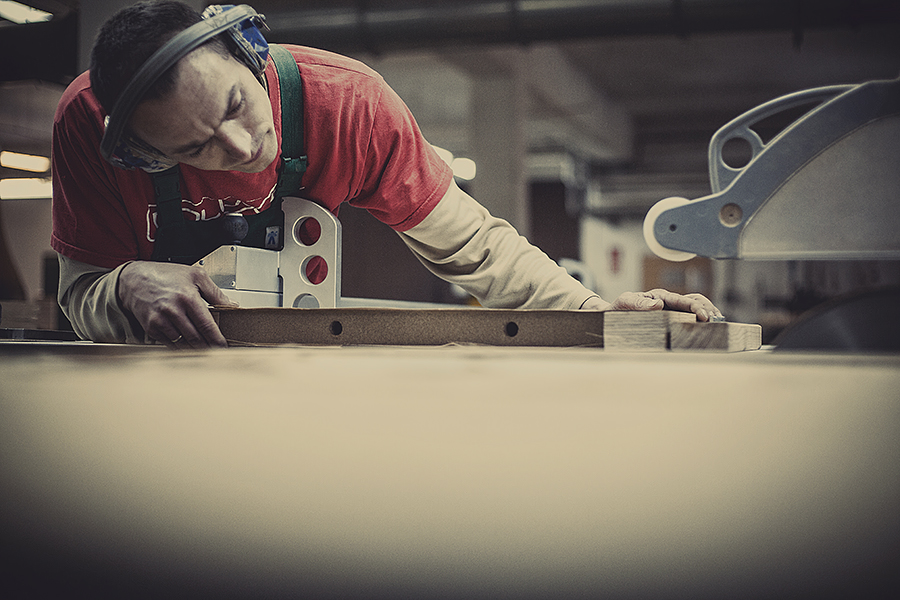
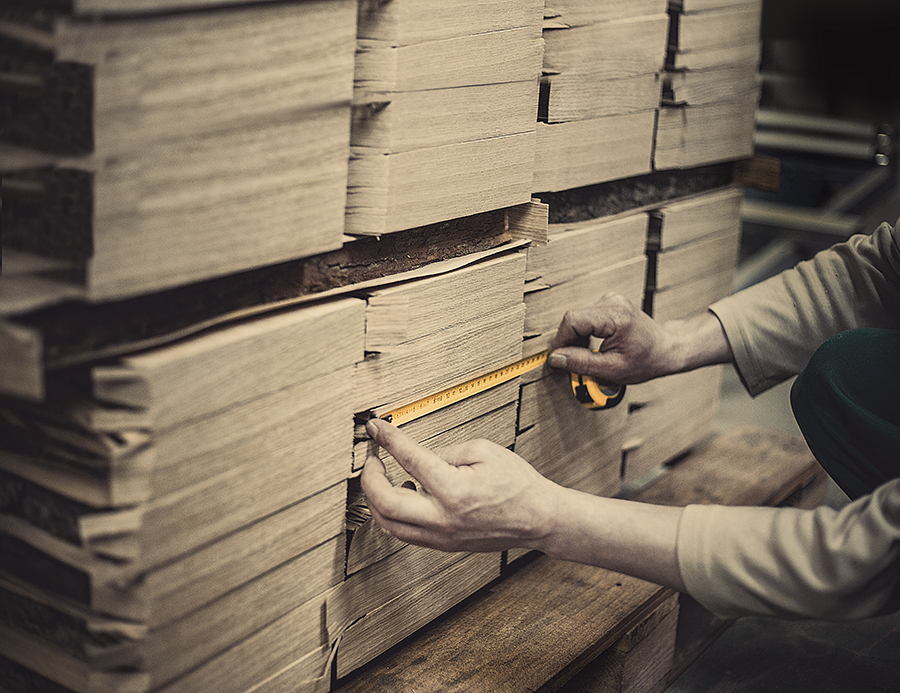
At Dolux, quality control is the foundation on which we base our reputation as a manufacturer of furniture of the highest quality. Our rigorous quality control system takes place at every stage of production, which guarantees that the final product meets the highest technical and aesthetic standards. A key component of this process is on-the-job quality control, which allows each component to be monitored and verified on an ongoing basis before it is passed on to the next stages.
Advanced measuring tools are used at each production station and are regularly calibrated. The calibration process follows strict procedures, ensuring accuracy and consistency of measurements. Thanks to this, we can be sure that each element meets precisely defined dimensional standards.
Bench quality control is not limited to measurements. Our team also performs visual assessments and checks the structural integrity of individual elements. Each product is carefully tested for compliance with design, dimensions and specific requirements, which allows to eliminate potential defects at an early stage of production. When we detect any imperfections, we immediately take corrective actions so that no defective element ends up in the final product.
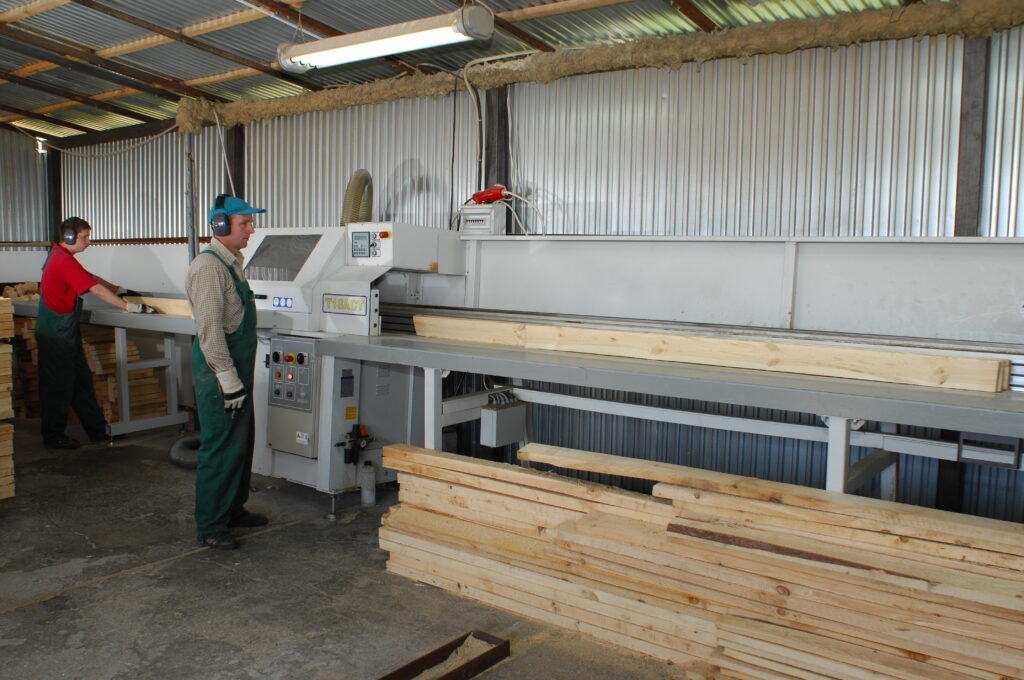
Planing lumber to the desired size
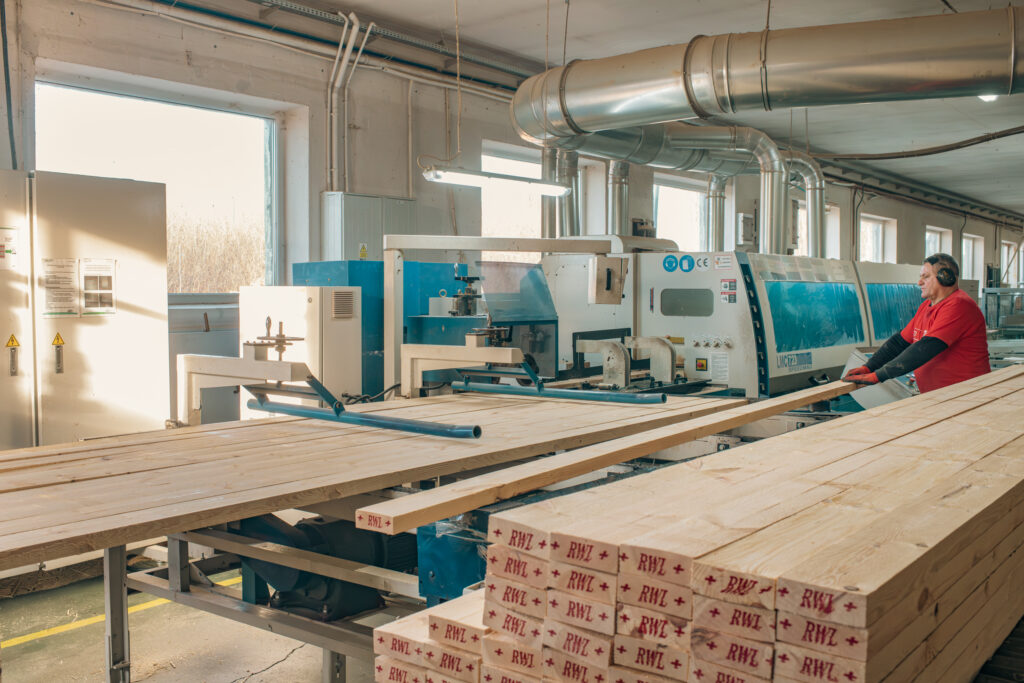
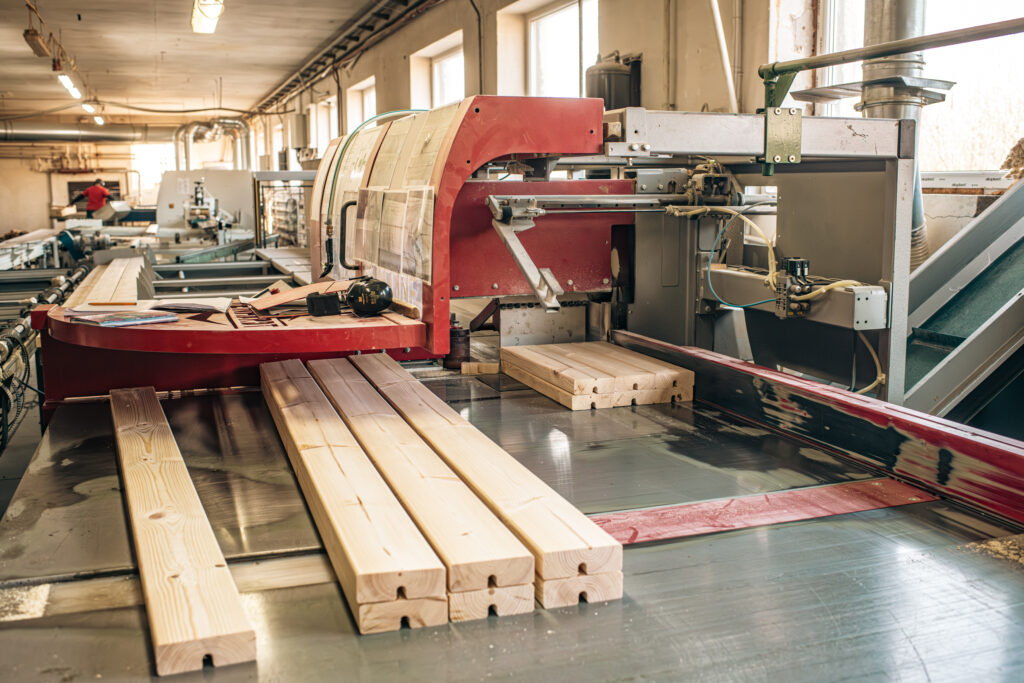
Timber Planing: We use a 4-sided, 7-head LeaderMac machine tool to achieve precise dimensions and smooth profiles.
Transport to the workstations – the finished, processed material is transferred to the next production stage by conveyor belts.
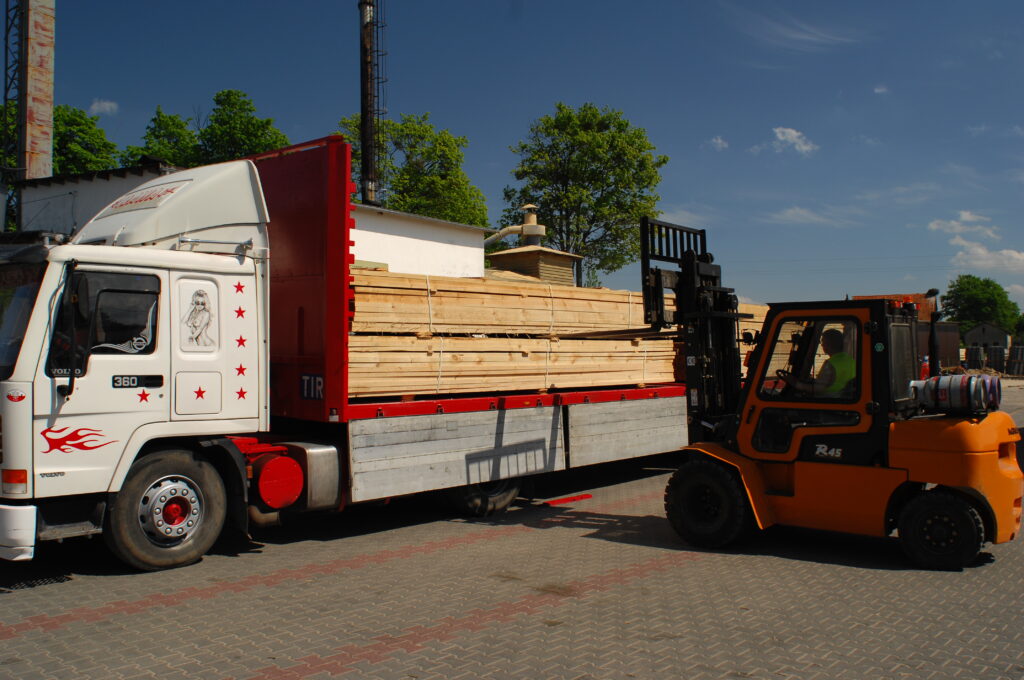
Delivery of raw material – the forklift operator places the lumber on an external roller feeder, from where it goes to the production hall.
Loading into the machine – the machine operator opens the gate with a button and then manually feeds the boards onto the conveyor belt, assessing the quality of the individual boards.
Planing – the lumber is planed on four sides, which allows to obtain the right dimensions and a smooth surface. And it can also broadcast a profile.
Quality control – workstation quality control of material according to the workstation inspection card
Cutting and vision inspection after machining
Stage of the production process: Technological After obtaining the required dimensions and smoothness of the lumber, the elements are pre-trimmed:
- Transport for further processing – the forklift operator transports the finished batches of material to the next stage, which is CNC machining.
- Cutting to the required lengths – the optimizer brings the planed timber to the appropriate lengths of the components
- Quality control – the operator makes a visual assessment of the wood structure, paying attention to knots and their impact on the quality of the component, m.in example.
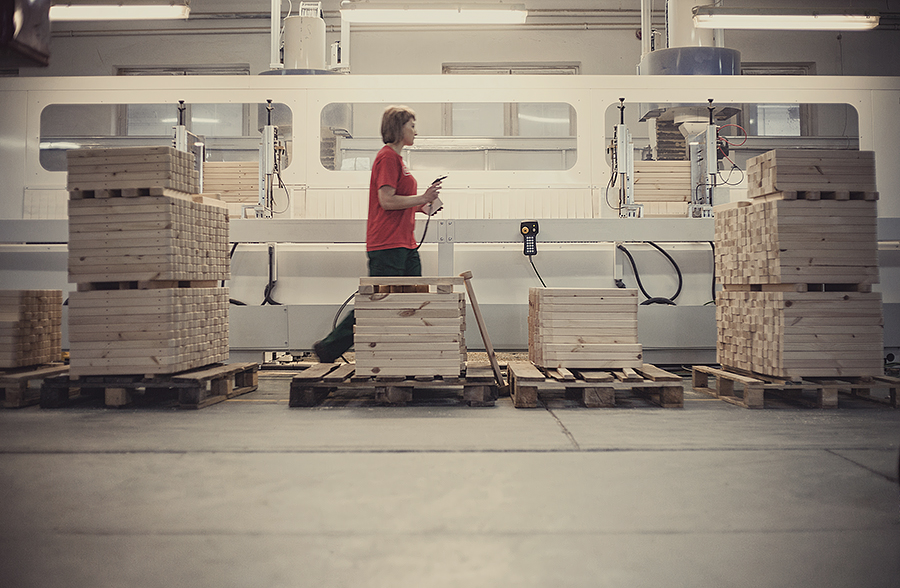
- Palletizing – the cut elements are placed on a pallet placed on a roller conveyor.
CNC machining at the FANUM center
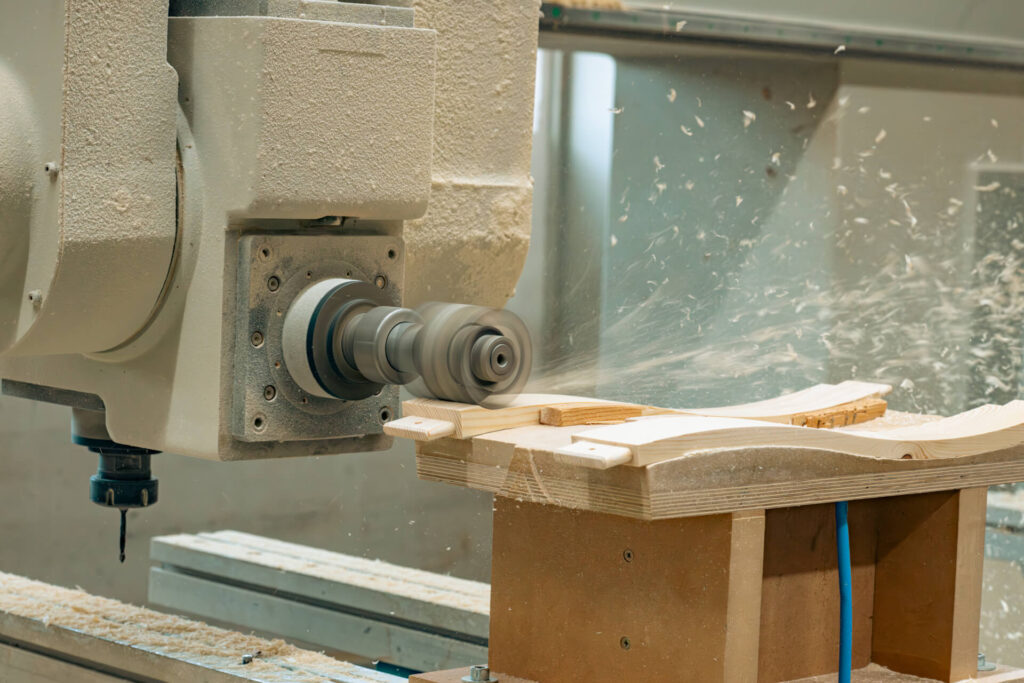
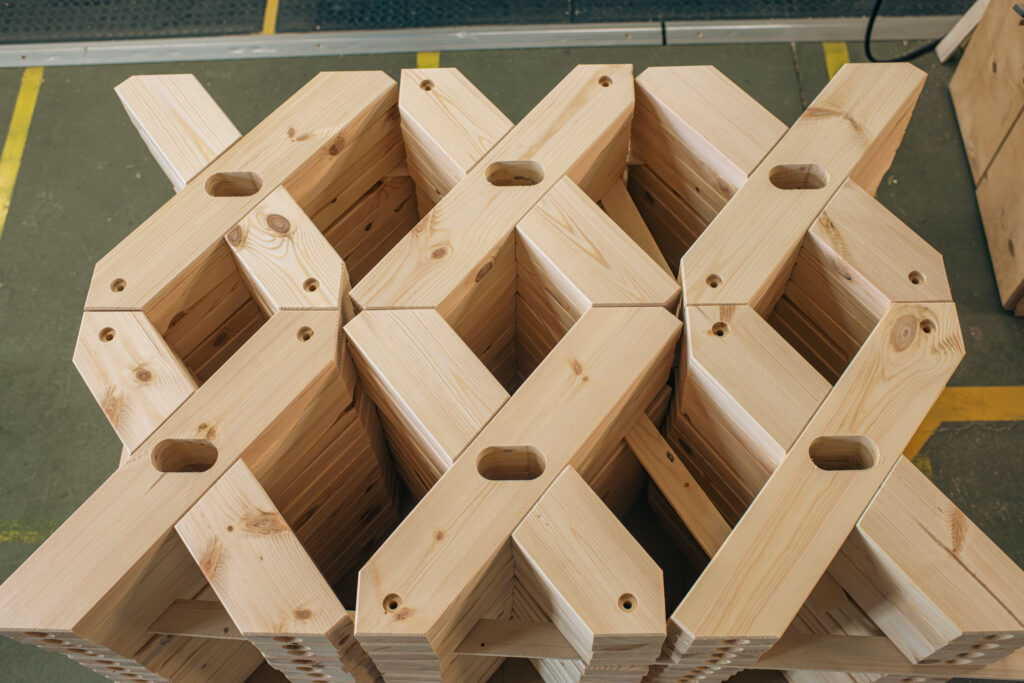
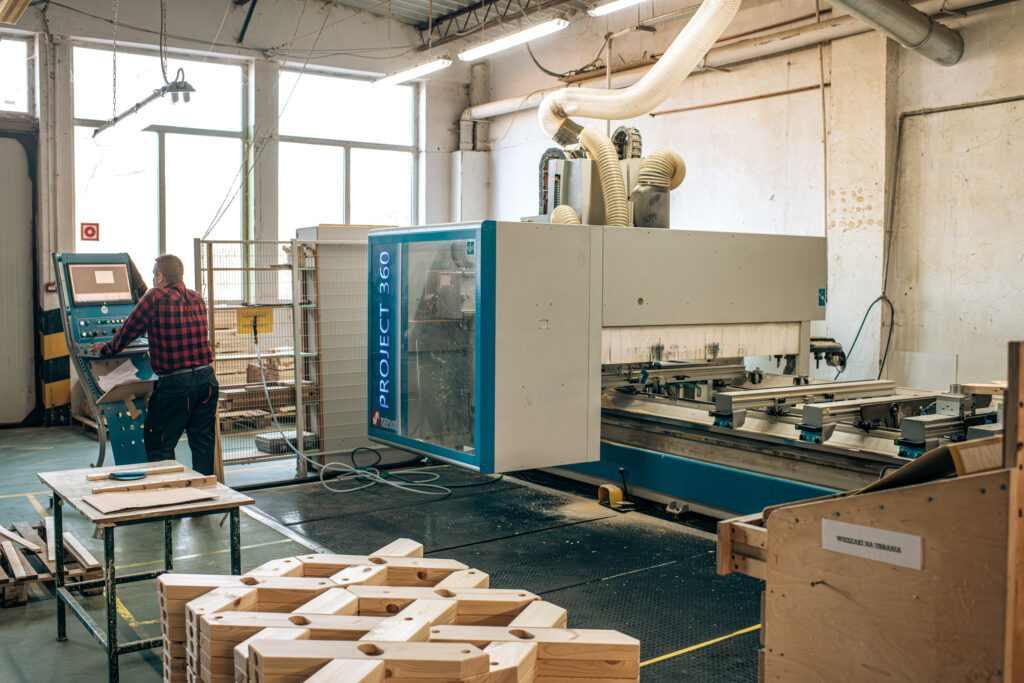
CNC Machining Centres: * FANUM Centre: Designed for precise milling and drilling of components, operating in up to 12 axes
- Buffer field – the elements are placed at the buffer station first.
- Loading – the operator manually picks up the elements and places it on the working field of the machine, which drives within his range for the duration of loading.
- CNC machining – the boom with the material moves to the working area, where, according to the selected program, milling and drilling, gouging and other milling operations are carried out (the FANUM center can work in 12 axes.
- Cleaning and grinding – after processing, the component returns to the operator’s field, where it is cleaned and possibly sanded by hand.
- Quality control – quality control of the component according to the station inspection sheet
- Putting down the finished workpiece – the operator places the finished element on a pallet.
CNC machining at the BACCI center
BACCI Centre: Specialises in shaping curved elements and complex drilling according to digital program guidelines
- Preparation of the program – the production technologist uploads the appropriate program to the machine, using a dedicated digital workstation.
- Loading elements – the operator picks up the elements from the pallet and places them on the machine’s movable feeders that drive up into the work area.
- Machining – curved elements are shaped, precise drilling and milling in wood is performed in accordance with the program guidelines.
- Finish – after the element returns to the operator’s working area, it is cleaned or sanded
- Quality control – quality control of the element in accordance with the station inspection sheet – dimensional and visual.
- Palletizing – the finished components are prepared for further stages (e.g. sanding, painting or assembly).
Custom Hole Drilling – Semi-Automatic Vertical Drilling Machine
Production process stage: Technological
This machine is used to make holes in places that cannot be made on CNC centers or require additional correction:
- Item Fetching – The operator retrieves the element from the palette.
- Positioning – with the help of a measuring instrument, it determines the exact place where the hole is to be made, based on a technical drawing.
- Drilling – the element is placed in the working area of the drill and drilled.
- Quality control – after each drilling, the operator checks the correctness of the performed operation, according to the station inspection card.
Multi-spindle through drilling machine
Precision Drilling: We utilise semi-automatic vertical and multi-spindle through-drilling machines for custom hole positioning in several planes
- Portal with drill supports – depending on the version, the supports can be placed at the bottom, side or top of the material.
- Pressure clamps – adjustable pressure beams allow for stable holding of the workpiece during machining.
- Drilling patterns – these can be adjusted and changed with couplings, allowing you to flexibly make a variety of holes.
- Quality control – quality control of the element in accordance with the station inspection sheet – dimensional and visual.
COMEC MD Plus+ CNC machining center
COMEC MD Plus+: A multifunctional CNC centre ideal for milling and chiseling, particularly for long workpieces
- Advanced spindles – allow for simultaneous machining of multiple planes.
- Precise adjustment – the machine allows you to make complex details in one clamping.
- Versatile use – adapted to both smaller and longer component formats.
- Quality control – quality control of the element in accordance with the station inspection sheet – dimensional and visual.
Sanding – EMC wide belt sander
EMC Wide-Belt Sander: Used for final smoothing and calibration, ensuring a uniform surface before the painting process
- Calibration – allows you to obtain a uniform surface of the material.
- Proper sanding – the treated surface is thoroughly smoothed, which is of great importance before the painting process.
- Quality control – quality control of the element in accordance with the station inspection sheet – dimensional and visual.
- Versatility – EMC wide belt sanders can handle a variety of wood-based and veneered materials.
Test assembly – quality control of the finished product
Our rigorous quality control system occurs at every stage. We utilise on-the-job inspections, where each component is verified before proceeding to the next phase.
Trial Assembly: Before distribution, all components are put together to verify compatibility, stability, and structural integrity.
Calibration: Advanced measuring tools are regularly calibrated to ensure every element meets exact dimensional standards.
Varnishing/impregnating and drying on the varnishing and drying line
Painting & Drying Line: Components are finished in a paint chamber where three layers of varnish or impregnation are applied evenly
- Loading – the operator manually places the plate (or other component) on the feeder.
- Varnishing/impregnating – in the paint chamber, two heads apply varnish/impregnation evenly in 3 layers.
- Drying – the product passes through the drying section, where the surface hardens under controlled conditions.
- Pick-up – the finished element leaves the line and is taken over by the employee.
- Quality control – quality control of the element in accordance with the station inspection sheet.
Manual Packing Line
Stage of the production process: Packaging
After the completion of all technological operations, the products go to the packaging area:
- Folding the carton – the employee takes the appropriate cardboard from the pallet and forms it in accordance with the guidelines of the order.
- Assembly of product elements – at subsequent positions, employees add individual elements, using the packaging diagram and technical data sheet of a given product.
- Documentation – in the last section, the necessary documents (instructions, certificates, etc.) are added to the cartons.
- Quality control – on-the-job quality control, taking into account the completeness of the elements of the packaged product, in accordance with the technical data sheet of the product.
- Closure – the carton is sealed and placed on a pallet, which is then transported by forklift to the warehouse.
Pallet wrapping on a semi-automatic wrapper
Production process step: Packaging
Protecting the filled pallets from damage and contamination is carried out on a semi-automatic wrapping machine from the manufacturer Pablo:
- Pallet transport – the forklift operator places the pallet in the working area of the wrapper.
- Foil wrapping – the machine automatically wraps the pallet with stretch film, the employee supervises the process and corrects any shortcomings.
- Labeling – after wrapping, the operator prints the label and sticks it on the pallet.
- Quality control – quality control of the packaged product.
- Storage – the secured pallet goes to the storage area.
Sawdust Combustion System – JARDREW
Production Process Stage: Technological (Dedusting System)
All machines and machining centers in the plant are connected to the central dedusting system. The sawdust and dust collected in the woodworking process goes to a special combustion unit of JAR-DREW:
- Container and hopper – the extracted material first goes to a container equipped with a fill sensor. When the container overfills, the system automatically directs the sawdust to the hopper.
- Transport to the furnace – from the hopper, with the help of screw and bucket feeders, the material goes to the combustion chamber.
- Thermal energy – burning sawdust allows you to recover thermal energy, which can be used to heat rooms or other processes in the plant.